Dogs
Fever DreamDogs are recurring presences in the novel’s rural setting, where they are more than background: a limping dog helps direct attention toward a green house, another dog’s death becomes a threshold in David’s behavior, and Mr. Geser’s dogs accompany a later drive without being noticed. Their appearances contribute to the story’s pattern of animal vulnerability and human efforts to interpret what is happening around them.
Encounters in the Rural Landscape
While tracing a route past fields and a stream, the narrator sees a dog emerge from a field near a row of modest houses. The next-to-last house is painted green, its color worn but still conspicuous against the landscape. The dog pants and wags its tail, but is missing a back leg. It crosses the street, looks briefly toward the narrator, and continues toward the houses. With no one else in sight, the narrator turns back, treating the encounter as a possible warning. The dog’s physical difference is thus a concrete clue within a search whose significance is not yet clear.
David and the Dog at Home
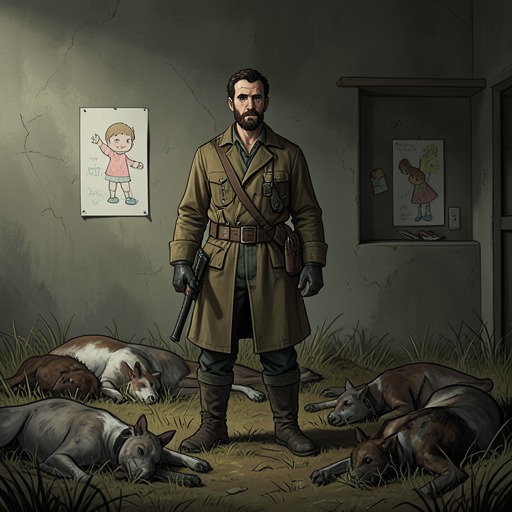
Carla later recounts that the dog made it to the stairs of David’s house and sat there for almost the whole afternoon. She asked David about it more than once; each time, he answered that the dog was not important. David then locked himself in his room and refused to come out. Only when the dog slumped to the ground, in a manner Carla recognizes from the ducks, did he emerge. He dragged the dog to the backyard and buried it. The sequence gives the animal’s death a particular place in David’s conduct: his withdrawal ends not when Carla questions him, but when the dog dies, and his response is to take responsibility for its burial.
Animals and the Story’s Pattern of Harm
The dog’s death sits within a wider pattern of animal distress and disappearance. In Carla’s account of an earlier incident, a stallion escaped its enclosure and drank from a stream while David was nearby. David knelt in the water and sucked on his fingers; Carla also found a dead bird close to him. The following morning, the stallion was gravely unwell. The account does not establish a specific substance or prove the dog’s death had the same cause, but it links animal vulnerability with the story’s recurring suspicion that the environment is unsafe.
That suspicion gathers force around the farm and its water. At a shed, men unload a truck full of large plastic drums, while the surrounding narrative frames the sight as important. Later, Omar discovers that all the horses have vanished, leaving a four-month-old foal alone in the pasture. These events do not identify what happened to the dogs, but they make the animals’ recurring presence part of a broader landscape of unexplained danger rather than isolated decoration.
The Drive Past Mr. Geser’s Yard
After Carla leads David and Nina back to the car, the three travel in silence past the house they had left that morning. Mr. Geser’s dogs race across the yard and beneath the privet hedges to run alongside the car, barking. The dogs are described as furious, yet neither David nor Carla appears to notice them. The scene contrasts the dogs’ energetic response with the passengers’ silence and exhaustion, while showing how attentiveness to animals shifts across the narrative: at one point a dog’s death brings David out of isolation; here, dogs are present and vocal but go unheeded.
Narrative Significance
Dogs appear in sharply different circumstances: one is a conspicuous, injured animal on a roadside; one waits at David’s home and dies; and Mr. Geser’s dogs run beside a car whose occupants do not react. The differences matter. The roadside dog’s appearance is treated as a clue, while the dog at David’s stairs becomes the focus of a quiet act of burial, and the dogs by the yard register a world continuing beyond the characters’ immediate awareness. Together with the dead bird and the troubled livestock, these moments make animals recurring witnesses to a countryside where signs of harm accumulate before their cause is understood.